Part 3 - Stop Asking AI Questions. Start Directing Outcomes.
AI becomes more useful when you treat its first response as a starting point rather than a finished product. By challenging assumptions, refining instructions, and independently verifying important information, you can use AI more effectively without surrendering your own judgment.
Stop Asking AI Questions. Start Directing Outcomes.
The first answer isn't always the best answer. It's often just the beginning.
One of the biggest mistakes people make when using AI is treating the first response as the finished product.
They ask a question, receive an answer, and move on.
But conversational AI offers something a traditional search engine doesn't: the opportunity to work through a problem, challenge assumptions, refine ideas, and improve the result through an ongoing exchange.
Imagine asking AI to develop a business proposal.
The first draft might be a useful starting point. But what happens when you ask it to identify weaknesses? Challenge its assumptions? Consider the proposal from a customer's perspective? Revise it based on your feedback?
The result can become substantially more useful.
The same approach works in software development, marketing, research, education, and countless other fields.
Instead of accepting the first response, try asking:
- What assumptions are you making?
- What important information might be missing?
- What are the weaknesses in this recommendation?
- What would you change if the goal were different?
- How can we improve this result based on these additional details?
These questions turn a one-time request into a collaborative process.
But collaboration doesn't mean blindly trusting the AI. It means actively directing the work while remaining responsible for evaluating the output.
AI can confidently produce inaccurate information. It can overlook important details or reinforce a flawed assumption. The more consequential the decision, the more important independent verification becomes.
The objective isn't to get AI to do all the thinking for you. It's to use AI to expand what you can accomplish while applying your own expertise and judgment.
The real advantage isn't asking AI more questions. It's knowing how to guide the conversation toward a better outcome.
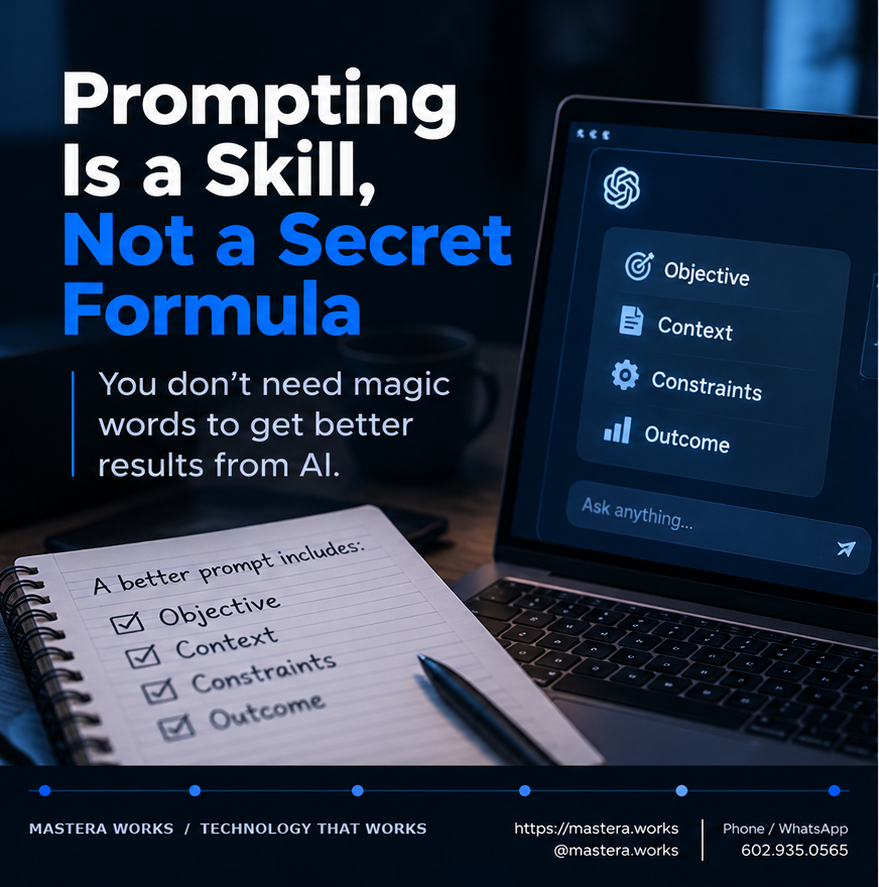
Across this series, we've explored three fundamentals: provide better instructions, understand the principles behind effective prompting, and refine the results rather than automatically accepting the first answer.
You don't need to become a prompt engineer to benefit from AI.
You need to learn how to communicate your goals, provide meaningful context, and evaluate what comes back.
Because access to AI is only the beginning. What you do with it makes the difference.